LED Masks Are All Over TikTok. We Fact-Checked the Claims.
"10 minutes = glass skin," "LED melted my fat," "masks cause eye damage" — the algorithm has opinions. We went through the viral LED claims one by one and sorted them into evidence, exaggeration, and nonsense. The results may surprise you in both directions.
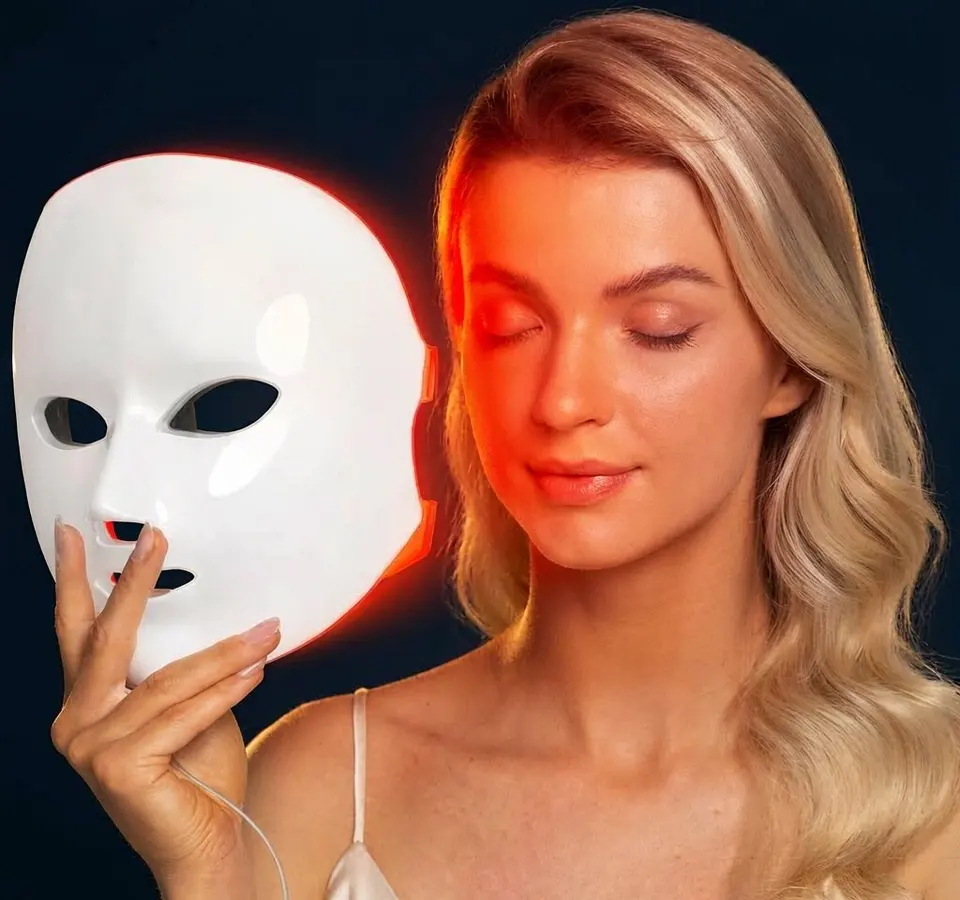
LED masks went from dermatologist-office hardware to a skincare-selfie staple in about three years, and the algorithm now confidently asserts things the actual literature has never said. We collected the claims with the most views attached and sorted them the only way that works: against the studies. Some viral claims survived contact with the evidence. Most didn't. A few things people fear about masks turned out to be more legitimate than the hype they're competing with.
CLAIM: "10 minutes a day = glass skin" — Verdict: directionally real, timeline fiction
The dose part is true: near-daily short sessions are exactly how the studies were run. The glass-skin-by-Friday part is not. Photobiomodulation works through collagen remodeling and cellular signaling, which move at the speed of biology — visible texture and tone changes take 4–8 weeks, and the full effect curves out over 12. If a before/after claims a fortnight, the filter did the work. The honest week-by-week arc is charted in our results timeline, and its shape is boring on purpose.
CLAIM: "Red light boosts collagen — dermatologists agree" — Verdict: TRUE, and weirdly underhyped
This is the strange one: the most boring-sounding claim on the platform is the best-supported one. Multiple controlled studies show 630–660nm red light increasing dermal collagen density and reducing fine-line depth over weeks of consistent use. The mechanism — light absorbed by mitochondrial chromophores, signaling cascades, fibroblast activity — is genuinely studied science, not wellness folklore. TikTok undersells this claim by dressing it up in the same voice it uses for the nonsense ones.
CLAIM: "LED masks cleared my acne" — Verdict: TRUE, with a regulatory asterisk
Blue light's anti-acne mechanism is real — we traced the porphyrin chemistry here — and cleared devices with an FDA-cleared acne indication are a legitimate mild-to-moderate play. The asterisk: the mask in the video needs to actually hold that clearance. A mask cleared only for wrinkles producing an acne testimonial is the category's most common sleight of hand, and it's checkable in the FDA's 510(k) database in about ninety seconds.
CLAIM: "My LED mask melted my face fat / healed my skin tags" — Verdict: FALSE
Red and blue light at consumer-mask doses do not destroy fat cells — that's a claim for clinical modalities with entirely different physics, and attaching it to a face mask is where credibility goes to die. Skin tags, moles, and cystic nodules are likewise outside anything a mask can or should touch. If a creator's LED content drifts toward lipolysis or lesion claims, that's your cue that the rest of the video wasn't fact-checked either.
CLAIM: "Masks wreck your eyes" — Verdict: exaggerated, but the underlying caution is real
The fear content overstates the risk, but it overstates a real thing. Consumer masks operate at intensities where ocular damage is unlikely with protection — and every mask worth buying ships with opaque eye shields, which exist for a reason. Blue light deserves the more careful handling. Our full breakdown, including which wavelengths warrant which caution, is in the eye-safety guide. Wear the shields. It costs nothing.
CLAIM: "Expensive masks work; cheap ones are toys" — Verdict: FALSE, and here's the test
Price is not a wavelength. A $170 mask with published 650nm output, an FDA-cleared indication, and a 2-year warranty outperforms a $470 mask with vague spectrum claims on every axis that matters — and the cost-per-session math makes the gap wider every month you own it. The category's real quality signal isn't the price tag; it's whether the brand publishes its clearance number, its nanometers, and its warranty without being asked. Ours are in the buyer's checklist — apply them to every brand on your feed, including ours.
The meta-lesson for your feed
LED therapy is one of the few viral skincare categories where the underlying physics and clinical literature are genuinely solid — which makes it uniquely vulnerable to hyped framing that borrows real credibility for fictional timelines. The filter for your FYP is the same three receipts: 510(k) clearance, published wavelengths, warranty with numbers. Creators with receipts, keep scrolling and take notes. Without them, scroll past — the science will still be true when you get to it.
Ready to Transform Your Skin?
Explore our LED devices — the 4D mask is FDA-cleared — and start your clinical skincare journey today.
Shop Collection