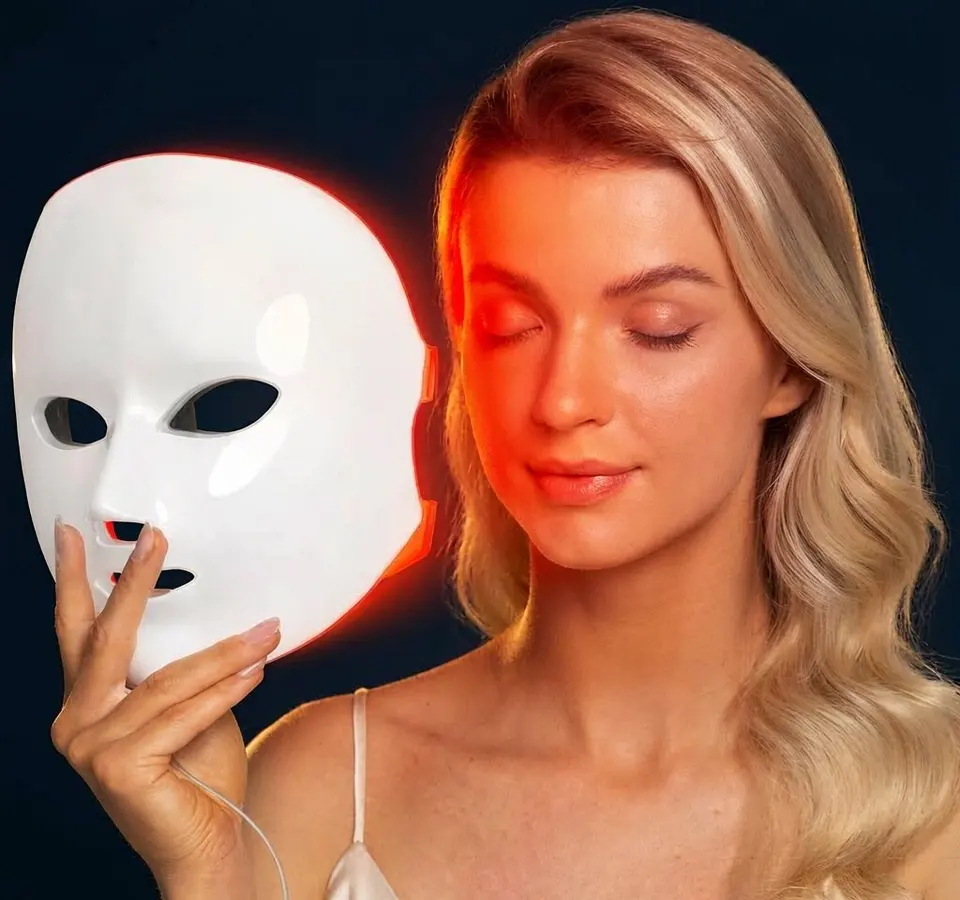
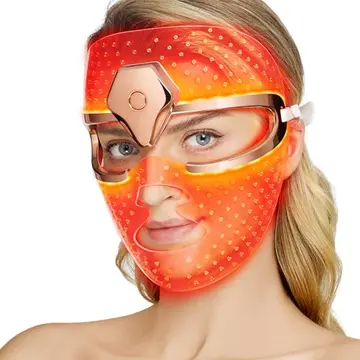
Skincare on the Go: How a Cordless LED Mask Fits Travel-Proof LED Therapy
Travel is the most reliable test of whether a routine survives. Corded versus cordless, battery realities, jet lag and the packing checklist.
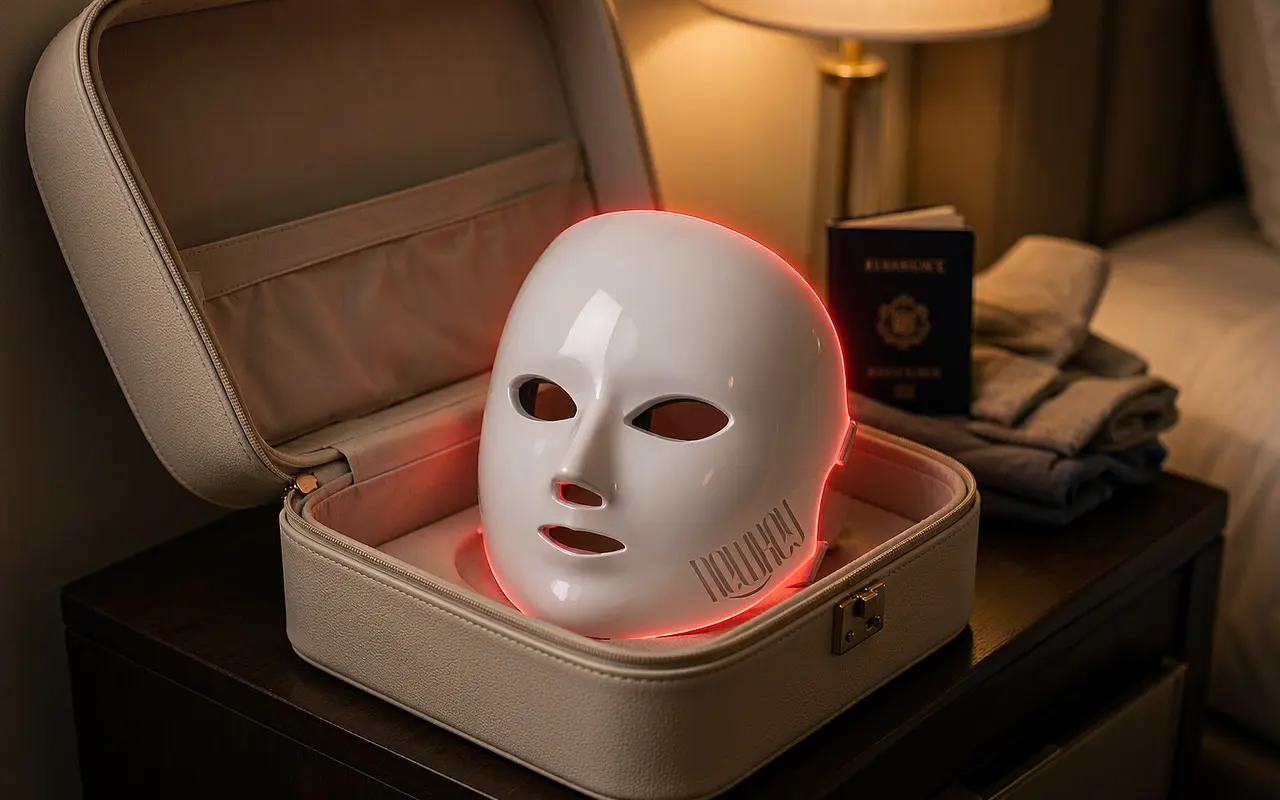
Routines rarely fail because people stop believing in them. They fail because the environment changes — a different bed, a different bathroom, a timezone that turns your evening into someone else's morning — and the routine was never designed to survive that.
Travel is the most reliable test of whether yours will. Here is how a cordless device fits into that, what it genuinely solves, and where it asks something back.
Why travel breaks skincare routines
Four forces act at once, and none of them is laziness.
- The routine loses its anchor. A routine lives on environmental cues — the bathroom, the mirror, the order you do things in. Remove the room and the cues go with it.
- Cabin air and hotel air are dry. Long flights dehydrate skin, and hotel heating or air conditioning does the same overnight. Skin that feels tight reads as "something is wrong," which usually triggers product-swapping at the worst possible moment.
- Days are unstructured. When you are out from morning until late, the ten minutes that fitted perfectly at home has nowhere to go.
- Packing forces triage. Something gets left behind, and devices with cables are usually first.
The last one matters most, because a device that stays home for a two-week trip turns a twelve-week protocol into a ten-week one — and photobiomodulation rewards cumulative dose, not intensity.
Corded and cordless are a real trade-off, not a tier list
Neither is better in the abstract. They optimise for different things.
| Corded | Cordless | |
|---|---|---|
| Output | Constant — no battery sag over the session | Depends on charge state |
| Weight on the face | Lighter, since the battery is elsewhere | Carries its own cell |
| Charging | None | One more thing to remember |
| Where it works | Near a socket | Anywhere |
| Best for | An established home routine | Travel, gym, small bathrooms, shared spaces |
The honest framing: a corded device gives you the most consistent output for the money, and a cordless one gives you the sessions you would otherwise skip. If your schedule is settled, corded wins on output. If your schedule moves, cordless wins on the only metric that ultimately matters, which is how many sessions actually happen.
What a cordless device actually buys you
It buys adherence, and that is not a soft benefit. In a twelve-week protocol, a device used four times a week outperforms a technically better one used twice — the dose-response relationship is cumulative, and skipped sessions are not recoverable by doing two in one evening.
Concretely, going cordless removes the specific situations where a session would otherwise not happen: the hotel bathroom with no convenient outlet, the ten minutes in an airport lounge, the evening you get in late and cannot face standing tethered to a wall.
What it asks back: battery reality
A cordless device has a limited runtime per charge, and that limit is affected by things worth knowing before a trip.
- Mode matters. Higher-output modes and combined-wavelength settings draw more power than a single low-intensity mode.
- Charge state matters for consistency. A partially charged device may not deliver its full output for the whole session, which quietly undermines the fixed-dose idea.
- Charge it before you leave, not at the hotel. A full charge from home is one fewer variable.
- Check the input voltage. Chargers designed for 100–240V work with a plug adapter alone. If yours is single-voltage, you need a converter, not just an adapter.
- Put the cable in a fixed pocket. The most common failure mode of a cordless routine is a cable that was packed in the checked bag.
Building a minimal travel kit
The goal is a routine that fits in one pouch. That means fewer products, not more:
- Gentle cleanser — travel sizes, or decant into a small bottle.
- One hydrating serum or hyaluronic acid. This earns its place more than anything else on a plane.
- One moisturiser that suits the climate you are going to.
- Sunscreen. Non-negotiable, and the one item worth buying locally if you run out.
- Your device and its cable.
Note what is absent: exfoliants and strong actives. Travel is a poor time to introduce them — skin is already dealing with dry air, unfamiliar water and disrupted sleep. Keep the actives for home and hold the LED schedule steady.
Fitting ten minutes into a travel day
The session is short, which makes it easy to place deliberately rather than hoping to find the time.
- After the shower. It is already a cue, and skin is clean and dry. This is the most reliable slot for most people.
- While unpacking or repacking. Ten minutes is about the length of a small suitcase.
- Before bed, once you are settled. Works well, though late arrivals make it the first thing to slip.
- Not on a plane. Cabin lighting, seat neighbours and the practicalities of eye protection make it a poor environment. Hydrate on the flight, do the session once you land.
Jet lag and the schedule
Timezones raise a question people worry about more than they need to: does moving your session by several hours break the protocol?
It does not. The cleared protocol is ten minutes per session, three times per week. It specifies a frequency, not a clock time. Shifting sessions by a few hours, or running Monday/Wednesday/Friday in one timezone and Tuesday/Thursday/Saturday in another, keeps you inside the dose range.
What does break a protocol is a nine-day gap. If a trip means you will miss sessions, a cordless device in the carry-on is a better solution than trying to compress the schedule afterwards.
A packing checklist
- Device, fully charged
- Charging cable, in a known pocket
- Plug adapter (voltage converter only if your charger is single-voltage)
- Eye shields
- Cleansing wipes or a travel cleanser for post-flight sessions
- One hydrating serum, one moisturiser, one sunscreen
- A soft pouch — the device sits against your face, so protect it from everything else in the bag
Where our devices sit
The Cordless LED Mask is built for exactly this scenario: switchable red, blue and combined modes in a rechargeable, lighter build, so a routine survives a two-week trip intact. The 4D LED Face Mask stays corded deliberately — constant output, no battery sag, seven calibrated wavelengths — which suits an established routine at home. Both run a fixed 10-minute auto-timed session.
Frequently asked questions
Can I take an LED mask on a plane?
In carry-on, yes — it is a personal care device, not a restricted item. If it is cordless it contains a lithium battery, so keep it in the cabin bag rather than checked luggage.
Will airport security question it?
Rarely. It is a plastic mask with an LED array. If asked, describing it as a light therapy device for skincare is accurate and usually sufficient.
Does the device work differently in a dry climate?
The light behaves identically. Your skin may not — dryness changes how comfortable a session feels and how quickly skin recovers, which is why hydrating after matters more when travelling.
Should I double up sessions if I miss some?
No. Photobiomodulation has an effective dose range, and stacking sessions moves you past the peak rather than catching up. Resume the normal cadence.
How many sessions does a charge give?
That depends on the model and the modes you use. Charge fully before travelling and treat the battery as a variable you have already eliminated.
Ready to Transform Your Skin?
Explore our LED devices — the 4D mask is FDA-cleared — and start your clinical skincare journey today.
Shop Collection