Red Light vs. Blue Light: Choosing the Right LED Therapy for Your Skin Goal
They share a delivery method and nothing else. How red and blue light differ in mechanism, depth and clearance — and how to run both in one routine.

Almost everyone shopping for an LED device ends up asking the same question in the same words: red or blue? It sounds like a preference — like choosing between two flavours of the same thing. It is not. Red and blue light share a delivery method and nothing else.
They are absorbed by different molecules, work at different depths, and are cleared for different conditions. Once you understand that, the choice stops being about which is "better" and becomes a straightforward match between a wavelength and the thing you want to change.
Two mechanisms, not two intensities
Red light works on your cells. It is absorbed by cytochrome c oxidase in the mitochondria, which increases ATP production and triggers signalling associated with repair and collagen activity. The result is skin that looks firmer and smoother over weeks of consistent use.
Blue light works on bacteria. It is absorbed by porphyrins produced by Cutibacterium acnes, the bacteria associated with inflammatory breakouts. That absorption releases singlet oxygen, which damages the bacterial cell. Your own tissue is largely a bystander.
This is the cleanest way to keep the two straight: red is a signal to your skin, blue is an attack on bacteria. A device that muddles them into "light therapy for all skin concerns" has not understood its own product.
Side by side
| Red light | Blue light | |
|---|---|---|
| Typical band | 630–660nm | 415–465nm |
| Absorbed by | Cytochrome c oxidase in mitochondria | Porphyrins in C. acnes bacteria |
| Reaches | Upper dermis | Epidermis (outer layer) |
| Acts on | Your cells | Bacteria |
| Cleared for | Full-face wrinkles (650nm) | Mild to moderate inflammatory acne (465nm) |
| Visible change | Weeks — texture, firmness, fine lines | Faster on active breakouts |
| Eye care | Shields recommended | Shields matter more — closer to UV |
Choosing by concern, not by colour preference
Start from what you want to change in three months, then read across.
- Fine lines, firmness, overall tone. Red. This is the range with the most research behind it and the one that reaches where collagen is produced.
- Active, inflamed breakouts. Blue. It targets the bacteria in the layer where they sit, without the drying irritation some topical treatments cause.
- Both. This is more common than either alone, and it does not require two devices.
- Neck and décolleté. Red plus near-infrared. The skin there is thinner and the target is deeper, which is why 850nm earns its place in a neck-specific device.
- Redness, dullness, uneven tone. Red as the base, with cosmetic green or yellow as support — remembering that those are claims about appearance, not treatments.
Can you use both in the same routine?
Yes, and most people with both concerns end up doing exactly that. There is no conflict between the wavelengths — they act on different targets through different mechanisms. The only thing to manage is total dose and your own skin's tolerance.
A simple weekly split that works for many people:
- Three red sessions for the anti-ageing side of the routine.
- Two blue sessions on breakout-prone days.
- One to two rest days where you use neither.
That keeps you inside the cleared protocol for each wavelength and inside the effective dose range for photobiomodulation generally. If your skin is reactive, start at three sessions a week total rather than five, and build up once it has shown it tolerates the routine.
Combined mode: convenient, with one caveat
Some devices offer a mode that runs red and blue together in a single session. It is genuinely convenient, and it is a reasonable default when you have both concerns and only ten minutes.
The caveat is that combining does not double the dose of either. You are splitting the session between two wavelengths rather than extending it for both. If you are treating a specific condition, dedicated sessions at the stated protocol will always be the more deliberate choice; combined mode is what keeps the routine sustainable on busy weeks.
Safety differences worth knowing
Neither wavelength is dangerous at the doses consumer devices deliver, but they are not identical in how they should be handled.
- Eye protection. Blue light is more energetic and sits closer to the UV end of the spectrum. Use the shields, and keep to the stated session length. Near-infrared is invisible, so you cannot judge your own exposure by how bright it looks.
- Deeper skin tones and blue light. Some practitioners suggest extra caution with blue light where there is a theoretical risk of post-inflammatory hyperpigmentation. If that applies to you, start conservative and watch how your skin responds.
- Fixed sessions. Both wavelengths follow the same biphasic dose curve — more is not better. A ten-minute auto-timed session is the dose, not a suggestion.
What neither wavelength will do
Being clear about the limits is more useful than another paragraph of enthusiasm.
Light therapy does not replace sun protection, and it does not reverse significant photodamage. It does not treat cystic acne — that is a dermatologist's territory. It does not produce overnight change, and it will not outperform consistency: four sessions a week in month three beats ten sessions in week one.
Where our devices sit
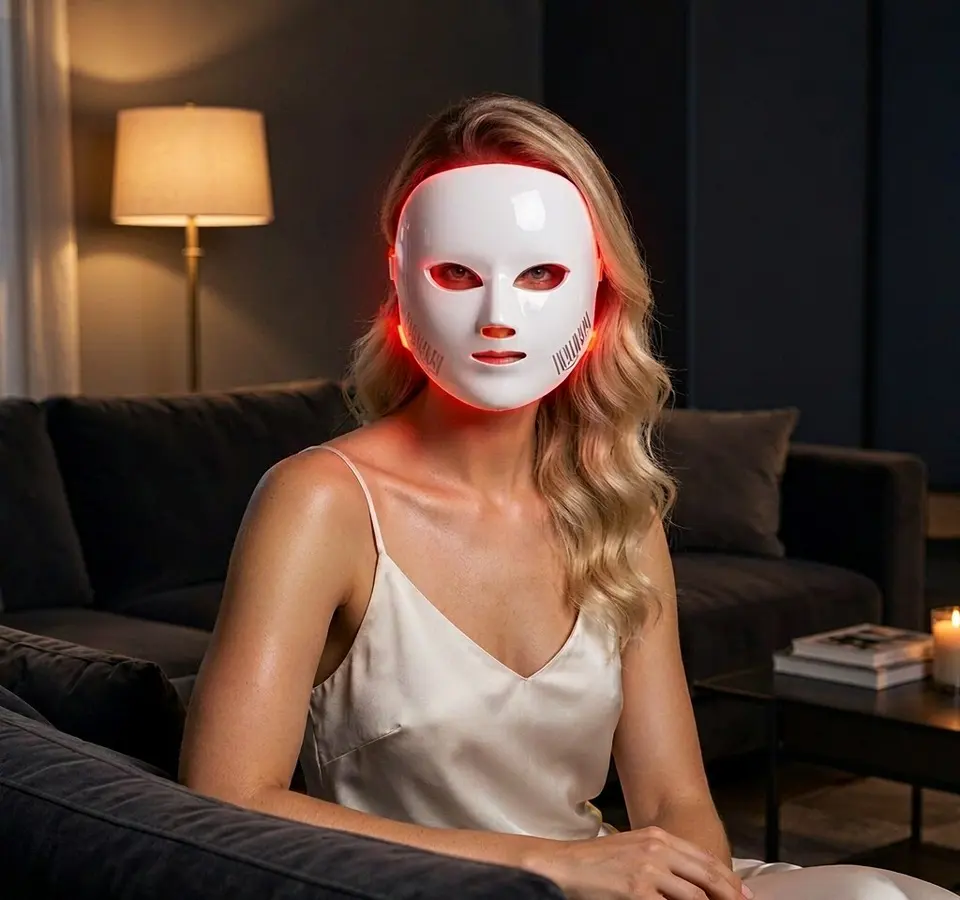
The 4D LED Face Mask carries seven calibrated wavelengths including cleared 650nm red for full-face wrinkles and cleared 465nm blue for mild to moderate inflammatory acne, running a fixed 10-minute auto-timed protocol. The Blue Light Therapy Mask pairs 465nm blue with 650nm red, concentrating its output along the T-zone and jawline where breakouts tend to cluster. The Cordless LED Mask offers switchable red, blue and combined modes in a rechargeable build for people whose routine happens away from a socket.
Frequently asked questions
Which one gives faster results?
Blue tends to show change sooner on active breakouts — manufacturer's guidance points to visible improvement after about five sessions. Red works on a slower clock: roughly twenty sessions before finer-looking lines and improved texture, with more visible change accumulating by weeks 8–12.
Can red light make acne worse?
Red does not target acne bacteria, so it will not clear a breakout on its own. It is not typically aggravating, but pairing it with blue is the more sensible approach if breakouts are your primary concern.
Do I need to choose one forever?
No. Many people move between them with the seasons — more blue in a breakout phase, more red for maintenance — without any penalty for switching.
Is a mask that does both weaker at each?
Not necessarily. Look at the published nanometer values and whether the device states a fixed session for each mode. What matters is whether each wavelength is present at a real, disclosed value — not how many colours are on the box.
Ready to Transform Your Skin?
Explore our LED devices — the 4D mask is FDA-cleared — and start your clinical skincare journey today.
Shop Collection