NEWKEY vs Omnilux: An Honest Comparison of Two FDA-Cleared LED Masks
We make one of these masks, which is exactly why this comparison tells you where Omnilux wins — 830nm near-infrared, a wireless flexible fit, and a clinical pedigree we do not have — and where the NEWKEY wins. Every regulatory claim on both sides is checked against the FDA's own 510(k) database.
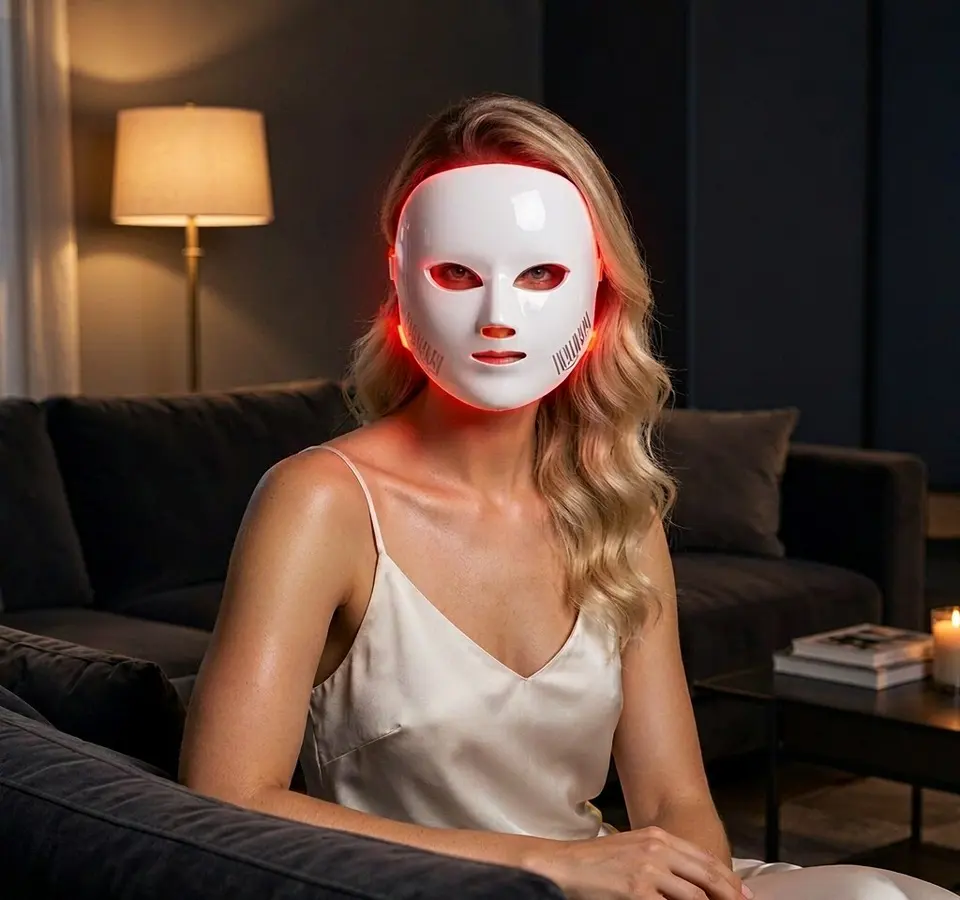
We make the NEWKEY mask. That sentence is the reason this article exists in its current form: a comparison written by the winner would be worthless if it hid the rounds the other side takes. So below you will find the sections where Omnilux simply beats us — near-infrared depth, a wireless flexible fit, and a clinical pedigree we do not have — stated plainly, next to the sections where the NEWKEY mask is the more rational buy. Every regulatory claim on both sides has been checked against the FDA's own 510(k) database, and we link the entries so you can verify us rather than trust us.
One piece of vocabulary before anything else: both devices discussed here are FDA-cleared, and neither is FDA-approved. Clearance (510(k)) means the FDA reviewed the device and found it substantially equivalent to a legally marketed predicate. Approval (PMA) is the far stricter pathway used for high-risk devices, and no consumer LED mask has it. Any brand calling its mask "FDA approved" is overstating its status — including, if it ever happened, us.
The one-paragraph verdict
If your goal is wrinkles only and you want the most comfortable device with the deepest-reaching wavelength, the Omnilux Contour Face is the better mask and the extra $225 buys real things. If you are treating acne alongside fine lines, or the price gap matters to you, the NEWKEY mask is the only one of the two with an FDA-cleared acne indication — the Omnilux cannot legally claim acne at all, because it emits no blue light. Most readers fall cleanly into one of those two camps, and the rest of this article is the evidence for that split.
Side by side: the verified specifications
| NEWKEY 4D Mask | Omnilux Contour Face | |
|---|---|---|
| Price | $169.99 | $395 |
| FDA clearance | Cleared May 5, 2023 | Cleared Sept 12, 2019 |
| Cleared indications | Full-face wrinkles and mild-to-moderate inflammatory acne | Full-face wrinkles only |
| Wavelengths emitted | Red 650nm, Blue 465nm | Red 633nm, Near-infrared 830nm |
| LED count | 150 LEDs / 450 light-emitting chips (manufacturer-stated) | 132 LEDs (commonly cited figure) |
| Irradiance | Up to 75 mW/cm² (manufacturer-stated, not independently verified) | ~30 mW/cm² claimed; ~28 mW/cm² in independent measurement |
| Form factor | Rigid 4D-contour shell, corded | Flexible silicone, fully wireless |
| Session | 10 minutes, auto shut-off, 3–5×/week | 10 minutes, 3–5×/week |
| Money-back window | 90 days | 30 days |
| Warranty | 2 years | 2 years |
Two rows in that table deserve an asterisk. Our irradiance figure comes from our own manufacturer documentation; Omnilux's claimed ~30 mW/cm² has been independently measured at ~28 — one of the more honest numbers in the category. And our "450 chips" counts three emitters per LED package, while the 132 figure counts Omnilux's LED packages. They are different units, and any comparison that pretends otherwise is flattering somebody.
Where Omnilux genuinely wins
1. The 830nm near-infrared wavelength
This is the single most substantive technical difference between the two masks. Red light in the 630–660nm range works mostly in the dermis; 830nm near-infrared penetrates deeper, reaching fibroblasts and the deeper vascular layers. The published photobiomodulation literature behind the 633 + 830 pairing is extensive, and it is the reason dermatology clinics built their LED protocols around this combination. The NEWKEY face mask has no near-infrared channel. If deeper-penetrating NIR is what you want against a face mask, Omnilux has something we do not sell. (Our neck mask, at $79.99, does emit 850nm NIR — but that is a different device for a different zone, and it is not a substitute for a face mask with NIR.)
2. The wireless, flexible-silicone build
The Contour Face is a flexible silicone shell with an untethered controller; ours is a rigid contour that plugs into the wall. Rigid shells hold LEDs at a fixed distance from the skin, which is an optical argument in our favor — but ten minutes of a session you cannot walk away from is a lifestyle argument against us, and it is a fair one. If being pinned to an outlet for ten minutes, three to five times a week, sounds like the habit-killer that stops your routine at week three, buy the wireless mask. Consistency beats optics.
3. Clinical pedigree and third-party verification
Omnilux descends from the Omnilux Medical in-clinic line, and its wavelength pair is backed by decades of published research — a heritage our bench-tested 510(k) pathway does not claim to match. Independent reviewers have also measured the Contour Face's output close to its claim, which is rarer in this category than it should be. We publish our manufacturer-stated figure and tell you it has not been independently verified; that is the honest position, but it is still the weaker one on paper.
4. Track record at scale
Omnilux reports 600,000+ customers and roughly 2,000 on-site reviews averaging 4.5 stars. Our review base is smaller by two orders of magnitude. That gap does not change what the photons do, but it does change how much survival data exists behind the product — and we would rather you weigh that than discover it later.
Where the NEWKEY mask genuinely wins
1. The acne indication — this is not close
The FDA cleared the NEWKEY mask for two indications: full-face wrinkles via red 650nm, and mild-to-moderate inflammatory acne via blue 465nm. The Omnilux Contour Face emits no blue light and holds no acne indication — its own labeling instructs users not to treat conditions outside its cleared list. If inflammatory acne is anywhere on your problem list, one of these devices can legally address it and the other cannot, regardless of price.
2. Price, and what $225 buys elsewhere
At $169.99 against $395, the NEWKEY mask costs 43% as much. Run the math over the two-year warranty at four sessions a week and the difference compounds: roughly $0.41 per session versus $0.95. The $225 delta is a year of a proven retinoid, or the neck mask below, or simply money. A wavelength advantage is real; it is not infinitely real.
3. The trial window
Photobiomodulation takes 8–12 weeks of consistent use before the visible changes are worth photographing. Our money-back window is 90 days; Omnilux's is 30. Given the biology of the treatment itself, a 30-day window expires before the results can plausibly appear — whichever brand offers it.
The wavelength question, honestly
Comparison marketing loves the nanometer derby, so here is the unglamorous version. Omnilux's 633nm red and our 650nm red are neighbors: both sit in the collagen-stimulating range, both are supported by published trials, and the depth difference between them is modest. Nobody has produced good evidence that 633 beats 650 or vice versa in a home mask — the honest reading of the literature is that the entire 630–660 band works, and brands pick a point in it. We will not claim our 650 is clinically superior to their 633, and you should be suspicious of any brand that does.
The near-infrared gap is different, and we covered it above: 830nm reaches tissue that visible red physically cannot, and Omnilux has it while our face mask does not. That is a real specification difference, not marketing arithmetic.
One disclosure from our own paperwork while we are being precise: our 510(k) description also lists an amber 605nm channel, but the mask we ship emits red and blue only, and our own spec table says exactly that. We would rather tell you that our clearance describes more than our product delivers than pad a feature list with a wavelength you will never receive. We mention it because the opposite habit — the "seven clinical wavelengths" style of copy that borrows swatches from a supplier diagram — is exactly what you should be shopping against.
Dose: why bigger irradiance numbers are not automatically better
Dose is irradiance multiplied by time, and photobiomodulation follows a biphasic response: too little does nothing, but too much can also underperform. This is why a mask claiming double the mW/cm² is not claiming double the result, and why "10 minutes, 3–5 times a week" is the protocol on both boxes rather than "as long as you like."
It is also why the irradiance row in the table needs context. Omnilux's ~30 mW/cm² (measured ~28) delivered for 10 minutes is a well-studied fluence. Our manufacturer-stated "up to 75 mW/cm²" would deliver more energy in the same ten minutes — which sounds like a win and is actually a reason to be careful, not proud. Independent measurement of our mask does not exist yet, and until it does, treat our number as a claim, not a fact. We are the ones telling you this.
The FDA paperwork, side by side
Both clearances are searchable, and we would encourage you to search them — this is the single best consumer habit in this category.
- NEWKEY: submitted by Shenzhen SUNGPO HI-TECH Electronic Co., Ltd; cleared May 5, 2023; Class II OTC device, product codes OHS/OLP, 21 CFR 878.4810; covers models MZ-01, NEWKEY-01 and SP-FM-01; cleared for wrinkles and mild-to-moderate inflammatory acne. Evidence basis: bench testing, biocompatibility (ISO 10993), electrical and photobiological safety (IEC 60601 series, IEC 62471), and substantial equivalence — like every 510(k), it did not require clinical trials.
- Omnilux Contour Face: cleared September 12, 2019 under the device name "faceLITE," filed by Ismart Marketing Services Ltd. The GUDID record for the retail mask cites this clearance. A quirk worth knowing: searching the 510(k) database for "Omnilux Contour" returns nothing, because the clearance predates the retail branding. That is a common industry pattern, not a red flag — but it is why the registry can be confusing.
Neither clearance involved clinical trials. Both rest on equivalence to previously cleared devices plus safety testing. When a brand implies its 510(k) proves efficacy, it is describing a standard no 510(k) meets — the honest claim is "safety-reviewed and cleared for these specific indications."
Cost per session, honestly calculated
| NEWKEY 4D Mask | Omnilux Contour Face | |
|---|---|---|
| Price | $169.99 | $395 |
| Sessions over 2-year warranty (4/week) | ~416 | ~416 |
| Cost per session | ~$0.41 | ~$0.95 |
| Money-back window | 90 days (~108 sessions) | 30 days (~36 sessions) |
Value math is only honest if it prices in what the premium buys. If the 830nm wavelength and the wireless fit are what get you to session 100, Omnilux's cost per session is buying the habit itself, and the premium is justified. If a cheaper mask is what you will actually use — because you can return it for three months and because $170 is an easy yes — then ours is the rational buy. Both sentences are true, and which one applies depends on your bank account and your bathroom, not on the marketing.
Who should buy which
Choose the Omnilux Contour Face if: wrinkles are your only target; you will use NIR's deeper reach; you want a flexible, wireless mask you can wear while moving around; the published-clinical-pedigree story matters to you; and $395 is comfortable. It is the more refined device, and this article loses nothing by saying so.
Choose the NEWKEY mask if: you are treating acne as well as fine lines (the deciding factor — Omnilux cannot treat acne); the price gap matters; a corded 10-minute session fits your routine; and you want a 90-day window long enough to actually see a result before deciding.
Consider both if budget allows: many experienced users stack red-light devices with NIR devices on alternating days. Our $79.99 neck mask (red 650nm + NIR 850nm, cordless) paired with our face mask still totals $249.98 — less than one Omnilux — though we will not pretend two $250 devices equal one $395 one in fit and finish.
Frequently asked questions
Is NEWKEY or Omnilux better for acne?
NEWKEY, and it is not a close call. The blue 465nm channel on our mask is part of its FDA clearance for mild-to-moderate inflammatory acne. The Omnilux Contour Face emits no blue light and holds no acne indication, so it is the wrong tool for that job at any price.
Is the Omnilux worth more than twice the price?
For wrinkles-only buyers who value the 830nm wavelength, the wireless flexible build, and the clinical lineage — often yes. For anyone who needs acne coverage or is price-sensitive, no. The premium buys real advantages; whether those advantages are worth $225 is a personal equation, not a fact.
Are either of these FDA approved?
No — and no consumer LED mask is. Both are FDA-cleared (510(k)) Class II devices. Cleared means reviewed for substantial equivalence and safety for specific indications; approved would mean the PMA standard used for high-risk devices. Treat "FDA approved" on any LED mask listing as a disqualifying sloppiness.
Which mask has better evidence?
Different kinds. Omnilux has stronger third-party verification (independently measured output) and a deeper published literature behind its wavelength pair. We have the broader cleared indication set (two conditions versus one) and full transparency on our own limitations. Neither 510(k) included clinical trials.
Can I use red light therapy and NIR together?
Yes — the wavelengths are complementary rather than redundant, and alternating or combined sessions are a common protocol. If you want both from NEWKEY, the face mask (650 + 465) plus the cordless neck mask (630 + 850) covers the pair for $249.98 total.
Sources and verification links
- The FDA 510(k) record for our LED Facial Mask — applicant Shenzhen SUNGPO HI-TECH Electronic Co., Ltd, cleared May 5, 2023 — is searchable in the FDA's 510(k) premarket notification database at accessdata.fda.gov.
- Omnilux Contour Face — cleared September 12, 2019 under the device name faceLITE (Ismart Marketing Services Ltd), as cited by the GUDID record for the retail mask — searchable in the FDA's 510(k) premarket notification database at accessdata.fda.gov.
- Omnilux Contour Face official product page (omniluxled.com): $395, 633nm + 830nm, wrinkles-only indication, 30-day guarantee, 2-year warranty
- Independent irradiance measurement of the Omnilux Contour Face (~28 mW/cm² vs ~30 claimed): ledmasklab.com and lighttherapyiq.com reviews
- 21 CFR 807.97 — misbranding by reference to premarket notification: the regulation that makes the claims in this article enforceable, for us and for everyone else
We make the NEWKEY 4D mask and profit when you buy it. We have linked the FDA database entries for both devices so you can check every regulatory claim in this article yourself — that habit will serve you better than trusting either brand, including this one.
Omnilux and any associated names and marks are the trademarks of their respective owners, used here only to identify the products being compared. NEWKEY is not affiliated with, endorsed by, sponsored by or otherwise connected to Omnilux. Specifications, prices, warranty and return terms were accurate as of the sources cited above and can change — where a current term matters to your decision, confirm it on the brand's own page before buying.
Ready to Transform Your Skin?
Explore our LED devices — the 4D mask is FDA-cleared — and start your clinical skincare journey today.
Shop Collection